

As our masts have become taller and heavier the design of the foundation of the mast has become more critical. Gone are the days of a simple ‘base plate’ made of some folded steel! Now the foundation needs to be able to support many tons of downward force, and also the complexities of multiple gin-poles and lifting dynamics.
With our keen knowledge of the installation and lifting parameters for masts up to 120 meters, we decided we needed to design a mast foundation that would meet our exact requirements.
Using Solidworks we were able to accurately model each component of the foundation, and more importantly understand their movement through the lifting process. The size of these masts means that there are actually two gin poles, the first lifts the second, and the second lifts the mast! In order to achieve this the second gin pole pivot has to act in two directions, the first at 90 degrees to the mast and the second in line with the main lift. The arrangement can be seen in this photo:
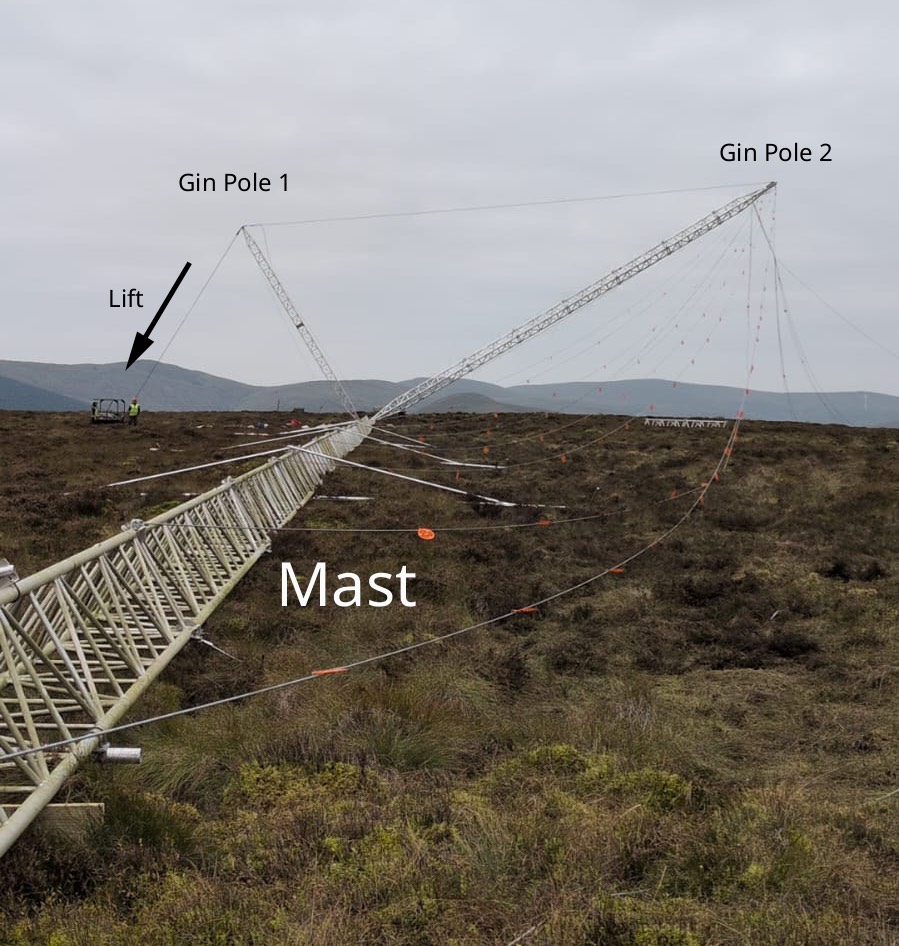
And in fact, the first gin pole needs a little help getting off the ground too, so we use a short ‘mini gin’ to start that lift! You can see the various planes of movement in this video taken from Solidworks (Gin Pole 1 is blue, Gin Pole 2 is yellow and the mast is green). Watch how the orange component allows the lift to effectively move through 90 degrees.
While the lifting load is born by the guy wires, the components of the foundation must support the forces running down the length of each gin pole and the mast itself. These loads run into many tons of force so it was important to ensure that all pivot points are as close as possible to the main axis. Furthermore, the ground can often be uneven and on a slope, so we built in 10 degrees of movement either side of horizontal for the ground foundation.
To ensure it would exceed the working loads we turned to our mast manufacturing partners, Retis, who ran FEA analysis on all the foundation members. We fed the changes they proposed back into the design in Solidworks before proceeding a final set of manufacturing drawings.
The result is a mast base that meets the stringent safety standards required to ensure we can be confident to safely install, climb and decommission masts even in the most demanding of locations, on time and on budget.